
Lifecycle
Understanding the Current State of Donor Engagement
2/6/20262 min read
Purpose of this perspective
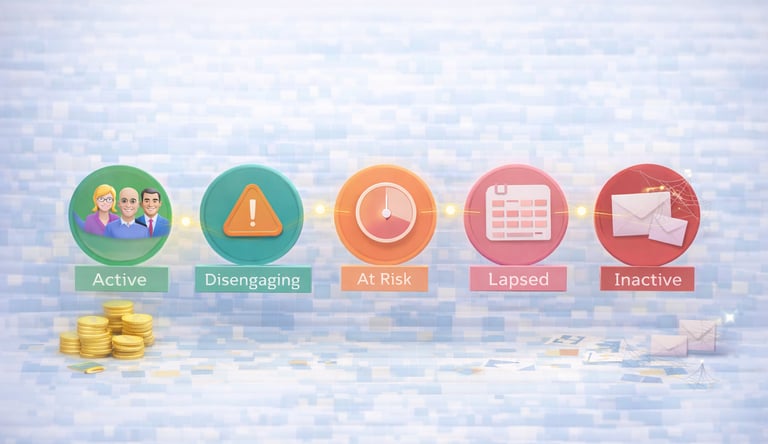
The Lifecycle perspective provides a snapshot of where donors currently stand in their relationship with the organization. It shifts the focus away from historical event reporting and toward present engagement states.
By grouping donors based on recent activity, this perspective treats donor status as a management signal. It helps organizations see where engagement is holding, where it is weakening, and where attention is most urgently needed to prevent loss or support momentum.
What this perspective looks at
Lifecycle focuses on the current distribution of the donor base. It examines both the volume of donors and the financial value associated with each engagement state.
Active donors
These are donors who are currently engaged. They form the core of the active file and represent the group that requires consistent stewardship to maintain their current level of participation.
Disengaging or at-risk donors
These donors are showing signs of slowing down or breaking from their usual giving patterns. Identifying this state early creates an opportunity to respond before donors transition into being lapsed.
Lapsed and inactive donors
These donors have not participated for a longer period. A distinction is made between those who are recently lapsed and those who have been inactive for years, as their likelihood of re-engagement and the nature of outreach differ.
Movement between lifecycle states (inflow and outflow)
Lifecycle tracks how donors move from one state to another over time. Seeing donors flow from lapsed back to active, for example, provides a clear view of reactivation dynamics within the file.
Value associated with each state
This perspective also looks at the historical value represented in each lifecycle state. When a significant share of past revenue sits with disengaging or at-risk donors, it brings financial exposure into clear focus and highlights where attention is most critical.
Some of the questions this perspective answers
Where do our donors stand right now, and how is the donor base distributed across states?
How much revenue is potentially at risk because it sits with disengaging donors?
How strong is our ability to bring donors back from a lapsed state?
Where is engagement weakening across the file, and where is it strengthening?
Which lifecycle states represent the most immediate concern for overall stability?
Want to explore how this approach might apply to your organization?
Curious to hear your challenges and ideas.
Address
Waltmanstraat 40
2136 BC Zwaanshoek
The Netherlands
Contact
info@fundraisinginsight.com
© 2026 Fundraising Insight. All rights reserved.