
RFM+T
Understanding the Behavioral Shape of Your Donor Base
2/6/20261 min read
Purpose of this perspective
The purpose of the RFMT perspective is to provide a structural map of the behaviors that sustain the organization.
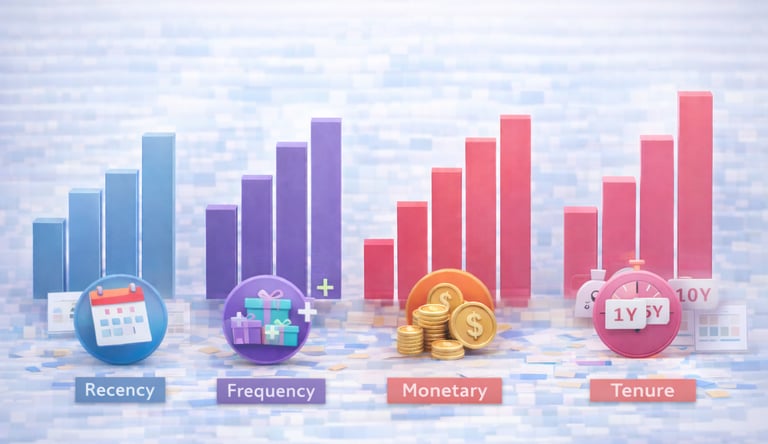
RFMT extends the traditional RFM view by adding Tenure, the length of a donor’s relationship with the organization. Alongside recency, frequency, and monetary value, tenure provides essential context for understanding whether observed giving patterns reflect short-term momentum or long-standing behavior.
While other perspectives focus on current participation or donor movement, RFMT highlights systemic reliability. It allows users to move beyond individual donor scores and see the behavioral pillars that collectively support revenue generation.
What this perspective looks at
Because RFMT combines four behavioral dimensions, it can easily result in hundreds of detailed segments that are difficult to interpret. Insight360 addresses this by grouping RFMT patterns into a small number of behavioral clusters that reveal structural reality rather than surface detail.
Examples of meaningful RFMT clusters include:
The Revenue Backbone
This cluster reveals where structural stability resides. It highlights the behavioral patterns, often characterized by repeat giving over longer tenure, that form the primary financial foundation of the organization.
Tenure Depth vs. Activity Intensity
By incorporating tenure, RFMT distinguishes between donors whose activity is intense but recent and those whose behavior has matured over time. This separation prevents short-term activity spikes from being mistaken for long-term stability.
Revenue Density Patterns
RFMT shifts attention from donor counts to contribution weight. By examining how revenue is distributed across behavioral clusters, it becomes clear which patterns carry the greatest financial significance.
Recent, But Not Yet Loyal
Large groups of donors may appear active because they have given very recently, yet their behavior is limited to one or two gifts. This pattern shows where momentum exists, but loyalty has not yet formed.
Some of the questions this perspective answers
How does tenure change the interpretation of donor activity?
Which behavioral patterns form the structural backbone of revenue?
Where is revenue most heavily concentrated across the donor base?
How much of current activity reflects established behavior versus short-term momentum?
Which behavioral clusters represent the strongest sources of financial stability?
Want to explore how this approach might apply to your organization?
Curious to hear your challenges and ideas.
Address
Waltmanstraat 40
2136 BC Zwaanshoek
The Netherlands
Contact
info@fundraisinginsight.com
© 2026 Fundraising Insight. All rights reserved.